When you’re shopping for replacement windows, you’ll hear a lot about vinyl. It’s durable, energy-efficient, and affordable. But have you ever stopped to wonder what actually goes into making a vinyl window? As someone who has spent years in the window manufacturing industry, I can tell you that the process is far more sophisticated than most people realize. Understanding how vinyl windows are made isn’t just interesting trivia—it directly impacts the quality, longevity, and performance of the windows you install in your home.
In this comprehensive guide, I’ll walk you through every stage of vinyl window production, from raw PVC pellets to a fully assembled, weather-tight window unit. I’ll also share the insider knowledge that separates premium windows from budget options, so you can make an informed decision for your next home improvement project.
The Raw Materials: Where Vinyl Windows Begin
Before we dive into the manufacturing line, let’s talk about what vinyl actually is. Vinyl windows are made from polyvinyl chloride, commonly known as PVC. This thermoplastic material starts as a white powder that gets mixed with additives to create the rigid, weather-resistant profiles you see in finished windows.
The quality of the raw PVC compound matters enormously. Premium window manufacturers use what’s called virgin vinyl—material that hasn’t been recycled or contaminated. This virgin resin produces frames that resist yellowing, warping, and brittleness over decades of sun exposure. Lower-cost windows often incorporate recycled vinyl or filler materials, which can lead to premature failure, especially in hot climates like Arizona.
Modern formulations also include titanium dioxide for UV resistance, impact modifiers for strength, and stabilizers that help the material maintain its structural integrity through temperature extremes. The exact recipe is proprietary to each manufacturer, and it’s one of the key differentiators between a window that lasts 30 years and one that starts failing after ten.
The uPVC Extrusion Process for Window Profiles
Once the PVC compound is properly mixed and heated, it enters the extrusion phase. This is where the magic happens. The uPVC extrusion process for window profiles is a continuous, highly controlled operation that transforms raw material into the precise shapes that form window frames and sashes.

upvc extrusion process for window profiles manufacturing line
Here’s how it works: The heated PVC compound is forced through a steel die—essentially a custom-shaped opening that determines the final profile of the window component. Think of it like squeezing Play-Doh through a shaped press, but at industrial temperatures and pressures. The die creates the hollow chambers, snap-in tracks for weatherstripping, and reinforcement channels that make modern vinyl windows so effective.
After exiting the die, the extruded profile passes through a calibration unit that maintains precise dimensions while the material cools. This cooling process is critical. If the profile cools unevenly, it can warp or develop internal stresses that lead to twisting later on. Premium manufacturers use vacuum-calibration systems and multiple cooling baths to ensure dimensional stability.
The resulting profiles are then cut to length and stored for fabrication. A single window may require multiple different profiles—the main frame, the sash, mullions for joining multiple windows, and various accessory pieces for glazing beads and trim.
Multi-Chambered Vinyl Window Frame Construction
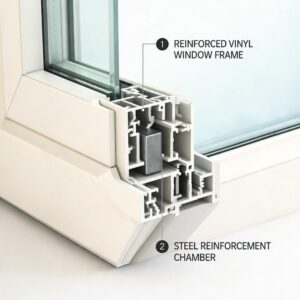
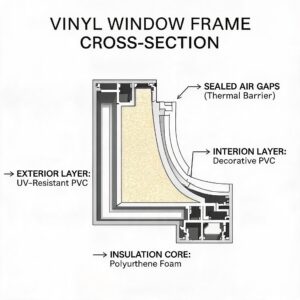
One of the most important innovations in vinyl window design is the multi-chambered structure. If you cut a vinyl window frame in half, you’ll see a series of hollow cavities running through the profile. These aren’t just empty space—they serve several critical functions.
The number of chambers in a frame directly affects its thermal performance. Each chamber creates an air pocket that acts as insulation, slowing the transfer of heat and cold through the frame. Basic windows might have three chambers, while high-performance models feature five, six, or even seven chambers. The multi-chambered vinyl window frame construction also provides structural rigidity, allowing the frame to support larger panes of glass without flexing.
In addition to the chambers, premium frames include reinforcement channels where steel or aluminum inserts can be placed. These reinforcements are essential for large windows or those in high-wind areas. The inserts prevent the frame from bowing or twisting under load, ensuring smooth operation for the life of the window.
The chamber design also accommodates drainage. Properly engineered frames have weeps—small channels that allow any water that gets past the weatherstripping to drain to the exterior. Poor drainage design is a common failure point in cheap windows, leading to water pooling inside the frame and eventual rot or ice damage.
Fabrication: Cutting, Welding, and Cleaning
With the extruded profiles ready, the fabrication process begins. This is where individual pieces of vinyl are transformed into complete window frames and sashes.
First, the profiles are cut to precise lengths using computer-controlled saws. The ends are cut at a 45-degree angle so they can be joined to form corners. Accuracy at this stage is non-negotiable—even a fraction of a millimeter off can result in gaps, misalignment, or windows that don’t open and close properly.
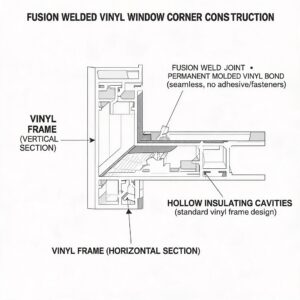
The cut pieces then move to a welding machine. The corners are heated to the melting point and pressed together under controlled pressure. This creates a fusion weld that is actually stronger than the surrounding material. When done correctly, the weld is virtually invisible and creates a permanent, watertight seal.
After welding, the corners go through a cleaning station where excess melted vinyl is trimmed away. This is done with automated routing tools that create smooth, finished corners. In premium manufacturing, this cleaning process is precise enough that the welded corner looks almost seamless—no rough edges, no visible weld bead.
The Insulated Glass Unit: The Heart of the Window
While the frame provides structure, the glass is where most of the energy performance comes from. Modern vinyl windows use insulated glass units, or IGUs, which consist of two or three panes of glass separated by a spacer and sealed to create an airtight cavity.
The glass itself is typically low-E coated, meaning it has a microscopically thin metallic layer that reflects infrared heat while allowing visible light to pass through. This coating is what keeps your home cooler in summer and warmer in winter. The cavity between panes is filled with an inert gas—usually argon or krypton—which provides better insulation than plain air.
The spacer that separates the panes is another area where quality varies dramatically. Traditional aluminum spacers conduct heat, creating a cold edge around the glass that can lead to condensation. Better windows use warm-edge spacers made from foam or reinforced plastic that minimize heat transfer at the glass edge.
The entire IGU is sealed with a primary seal (typically polyisobutylene) and a secondary seal (silicone or polysulfide) to prevent moisture infiltration. If this seal fails, the window will fog between the panes—a common problem with budget windows that signals the unit needs replacement.
Assembly: Bringing It All Together
With the frames welded and the glass units prepared, the final assembly begins. This stage requires careful attention to detail to ensure the window functions properly for years to come.
The sash—the moving part of the window—is fitted with weatherstripping along all contact surfaces. This creates a tight seal when the window is closed, preventing air and water infiltration. The type of weatherstripping matters: bulb seals, fin seals, and magnetic seals each have different performance characteristics. Premium windows often use multiple layers of weatherstripping for maximum protection.
Hardware installation is another critical step. The locking mechanism, hinges, and balance system (for double-hung windows) must be properly aligned and secured. Poor hardware installation leads to windows that stick, sag, or fail to lock securely.
The IGU is then set into the sash or frame using glazing tape or silicone, and held in place with snap-in glazing beads. These beads must be installed evenly to avoid putting stress on the glass, which could cause breakage later.
Quality Control and Inspection
Before any window leaves the factory, it undergoes rigorous inspection. This is where the difference between a quality manufacturer and a commodity producer becomes most apparent.
Every window is checked for dimensional accuracy—width, height, and squareness must fall within tight tolerances. The welds are inspected for strength and appearance. The glass is examined for scratches, chips, or defects in the low-E coating. The weatherstripping is tested for proper compression, and the hardware is cycled multiple times to ensure smooth operation.
Some manufacturers also conduct water and air infiltration tests on sample units from each production run. These tests simulate extreme weather conditions to verify that the window will perform as designed. A window that passes these tests will keep your home dry and comfortable even during monsoon rains or high winds.
Tell-Tale Signs of a High-Quality Vinyl Window
After years in this industry, I’ve learned what separates exceptional windows from mediocre ones. Here are the key indicators to look for:
- Virgin vinyl content: Ask whether the manufacturer uses virgin PVC or regrind. Virgin vinyl resists yellowing and maintains its structural integrity longer.
- Chamber count: More chambers mean better insulation and rigidity. Look for at least five chambers in the frame and sash.
- Weld quality: Run your finger along the corner welds. They should feel smooth and uniform, with no gaps or rough spots.
- Reinforcement: For windows larger than about 3 feet in any dimension, steel or aluminum reinforcement is essential. Check that it’s present and properly secured.
- Warm-edge spacers: These reduce condensation and improve overall energy efficiency. Avoid windows with aluminum spacers.
- Comprehensive warranty: A good manufacturer stands behind their product with a transferable warranty covering both the frame and the glass unit.
The Bottom Line for Homeowners
Understanding how vinyl windows are made gives you tremendous leverage when shopping for replacements. You can ask informed questions, recognize quality features, and avoid the pitfalls of cheap construction. The manufacturing process I’ve described represents the gold standard—what you should expect from a reputable window company.
At the end of the day, a vinyl window is only as good as the materials and workmanship that go into it. The extrusion process, chamber design, welding quality, and glass unit construction all contribute to the final product’s performance and longevity. By choosing windows built to these standards, you’re investing in comfort, energy savings, and peace of mind for decades to come.
Frequently Asked Questions About Vinyl Window Manufacturing
Q: How long does it take to manufacture a vinyl window?
A: From extrusion to final inspection, a custom vinyl window typically takes 2-3 weeks to produce. Standard sizes may be available more quickly from inventory.
Q: Can vinyl windows be recycled?
A: Yes, vinyl is fully recyclable. Many manufacturers collect scrap from the production process and reuse it in non-structural components. At end of life, vinyl windows can be ground down and recycled into new products.
Q: Why do some vinyl windows turn yellow?
A: Yellowing is caused by UV degradation of the PVC compound. Premium windows use titanium dioxide and other UV stabilizers to prevent this. Windows made with recycled or low-quality vinyl are more prone to yellowing.
Q: Are triple-pane windows worth the extra cost?
A: In most climates, triple-pane windows offer marginal improvement over high-quality double-pane units. They become more beneficial in extreme northern climates or for windows facing noisy streets.
Q: What is the typical lifespan of a well-made vinyl window?
A: With proper installation and maintenance, a quality vinyl window should last 25-35 years. The frame itself can last longer, but the insulated glass unit may need replacement sooner if the seals fail.
Q: Do vinyl windows expand and contract with temperature changes?
A: Yes, vinyl has a higher coefficient of thermal expansion than aluminum or wood. Quality windows are designed with this in mind, using proper clearances and flexible sealants to accommodate movement without compromising performance.